Setting The Record Straight: Key Facts About America’s First Transcontinental Railroad
Download PDFThe Union Pacific-Norfolk Southern combination is about strengthening America’s competitiveness, delivering exceptional customer service, enhancing the safety of freight transportation and safeguarding union jobs.
Opponents see a competitor that will be faster, delivering service with fewer touch points and fewer complications for customers. They know that to compete, they will need to improve their service, lower their price or both — and that is at the heart of their concerns.
Opponents see a competitor that will be faster, delivering service with fewer touch points and fewer complications for customers. They know that to compete, they will need to improve their service, lower their price or both — and that is at the heart of their concerns.
OPPOSITION: The STB’s “incomplete” ruling signals challenges for the merger of Union Pacific and Norfolk Southern.
FACT: Responding to additional questions is a normal part of the regulatory process.
- The STB often suggests refiling with additional information before ultimately approving an application.
- Our team is preparing to submit an updated application that addresses the points raised by the STB.
- The merger closing is still targeted in the first half of 2027.
OPPOSITION: There is broad opposition to the transaction.
FACT: Support is extensive and unprecedented, including record engagement from customers and labor.
- Union Pacific’s historic merger application was accompanied by more than 2,000 letters of support ― the most submitted in STB history.
- More than 500 shippers, 800 public officials and community leaders, and 700 other rail industry stakeholders have voiced support for the transaction.
- The merger is supported by the nation’s largest rail labor organization, the International Association of Sheet Metal, Air, Rail and Transportation Workers — Transportation Division (SMART-TD), International Association of Sheet Metal, Air, Rail and Transportation Workers — Mechanical and Engineering Department (SMART-MD), as well as National Conference of Firemen and Oilers (NCFO), Brotherhood of Railway Carmen (BRC), International Brotherhood of Boilermakers (IBB) and United Supervisors Council of America (USCA).
OPPOSITION: Gateway pricing proposals have uncertain effects.
FACT: The open gateway promise and Committed Gateway Pricing (CGP) are additive, voluntary and enforceable.
- The combined company will voluntarily embrace the same robust and readily enforceable open gateway requirement and bottleneck pricing conditions the STB imposed in the recent CP-KCS merger. This includes keeping open all existing gateways for eligible traffic on commercially reasonable terms.
- Furthermore, CGP will streamline pricing of interline moves for thousands of customer locations that otherwise may not directly benefit from the merger.
- CGP will also extend the merger’s pro-competitive benefits to more customers, allowing them to benefit from efficiencies and competition they wouldn’t otherwise access.
OPPOSITION: Growth projections for the combined company are unrealistic.
FACT: Extensive studies by industry-leading economists show single-line service will unlock significant rail growth by shifting freight from trucks and capturing unmet demand across key markets.
- Trucking has gained nearly 10 points of market share since 2014, according to Bureau of Transportation statistics; the merger will begin to reclaim that market share.
- When a single-line rail service is available, the share of freight traveling by rail versus the highway is roughly two to three times greater than interline service.
- Oliver Wyman projects the combined company will convert an estimated 2 million truckloads of traffic from road to rail annually, providing customers a more cost-effective and efficient option.
- The combined railroad will capture untapped Watershed market opportunity — for the first time, these shippers will have access to single-line manifest service.
- Oliver Wyman estimates 105,000 carloads of merchandise traffic will convert from road to rail when single-line service is available to the Watershed markets.
OPPOSITION: Union Pacific’s Service Integration Plan relies on a “trust us” approach.
FACT: The merger is backed by a detailed, phased integration plan — building on both companies’ proven track records of managing large, complex systems changes — designed to protect service and improve reliability.
- The combined railroad anticipates investing an incremental $2.1 billion to integrate the two companies and deliver customer benefits.
- A unified operating plan will optimize routing, eliminate unnecessary interchanges and improve service without overhauling existing networks.
- Changes will undergo extensive testing and strict management procedures prior to implementation, in addition to phased customer service changes, thorough employee training and active customer engagement.
- Most traffic, yards and terminals will see little to no operational impact due to the end-to-end nature of the merger.
- Union Pacific’s modern operating systems, including Positive Train Control, Computer-Aided Dispatch and NetControl, will support safer, more efficient operations.
OPPOSITION: Union Pacific’s plan doesn’t enhance competition.
FACT: The merger is pro-competitive. It will deliver faster, more reliable single-line rail service that strengthens competition for shippers and consumers, helps rail compete more effectively with trucking, and supports a more competitive
U.S. economy.
- Shippers will gain better scheduling and more consistent service, which has already prompted competitors to respond with new products and improved offerings.
- The combination will increase industrywide competition, and lower costs through efficiencies that put downward pressure on prices.
- Stronger service will position rail to compete head-to-head with trucking, pairing rail’s efficiency with trucking’s simplicity.
- Single-line access to more than 100 ports and 10 international gateways will make American businesses more competitive in global markets.
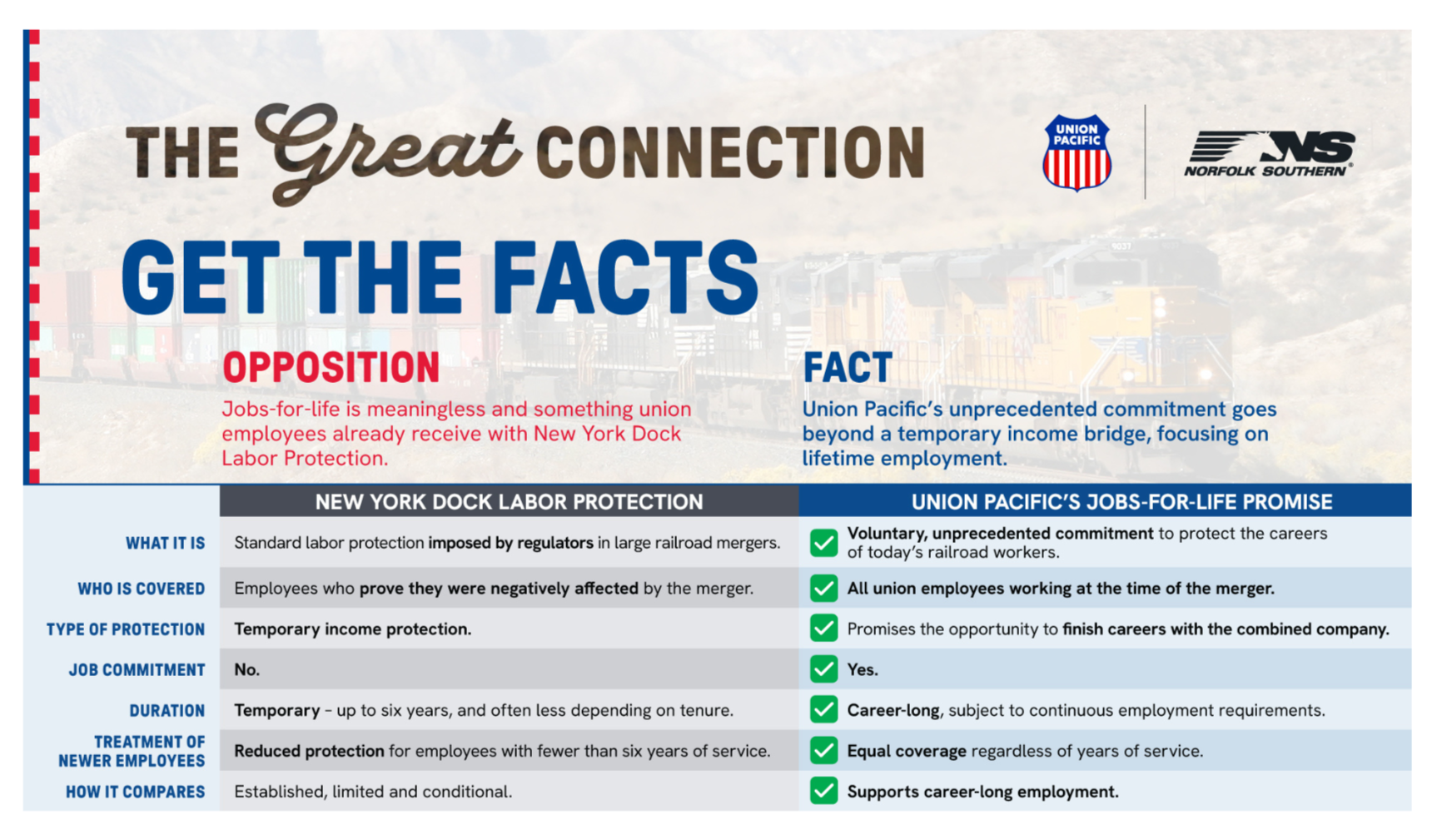
OPPOSITION: Jobs-for-life is meaningless and something union employees already receive with New York Dock Labor Protection.
FACT: Union Pacific’s unprecedented commitment goes beyond a temporary income bridge, focusing on lifetime employment.
- Traditional labor protection offers up to six years of income protection (with reduced protection for less than six years of service); it only covers employees who can prove they were negatively impacted by the merger.
- Union Pacific’s jobs-for-life commitment promises union employees the opportunity to finish their careers with the company — regardless of tenure — subject to the usual requirements for continued employment.