Strengthening Supply Chains: How a Union Pacific–Norfolk Southern Combination Will Accelerate Freight Delivery
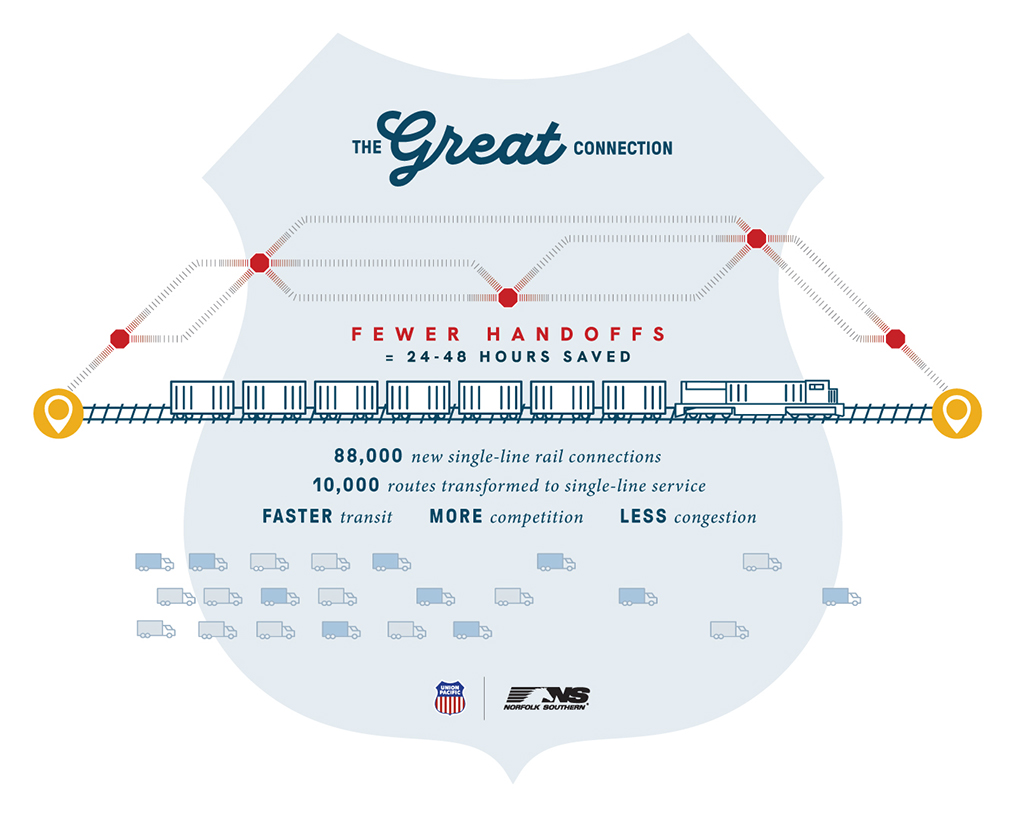
● Single-line service will save shippers 24-48 hours. The Union Pacific–Norfolk Southern combination will eliminate thousands of time-consuming interchanges, allowing freight to move across one seamless network from origin to destination.
● Fewer handoffs mean greater reliability. The combined network will reduce thousands of daily transfer points, eliminating 2,550 rail car and container handlings and roughly 65,000 car miles each day.
● Customers gain a stronger alternative to long-haul trucking. Faster transit times, greater service consistency and a single point of accountability will help manufacturers, retailers and agricultural producers compete more effectively.
Every Hour Matters in Modern Supply Chains
Among the many benefits of the proposed Union Pacific-Norfolk Southern combination, one stands above the rest for businesses facing rising customer expectations and increasingly complex supply chains: faster, more predictable transit times.
Today, freight moving between eastern and western markets changes hands between railroads through interchange points that can add 24 to 48 hours to a shipment’s journey. Each interchange requires multiple steps, including breaking apart trains, switching cars in yards, assembling new trains and inspecting new trains. In many cases, these steps must be repeated within the same interchange city as freight moves between different railroads, adding further complexity and delay to the shipment’s journey.
Back-office processes must be managed and executed for each rail carrier as well, including billing processes and coordination across multiple customer service systems. Even when every handoff occurs exactly as planned, each additional step adds complexity, time, and opportunities for delay.
In modern supply chains, every step matters. Manufacturers rely on precise delivery schedules to keep production lines running. Retailers need inventory on shelves when customers expect it. Agricultural producers, energy customers and industrial shippers depend on efficient transportation to reach domestic and global markets.
Every hour a shipment spends waiting at an interchange or trucked between transfer points is time businesses cannot recover.
How a Unified Network Improves Freight Movement
The combined network will convert thousands of existing interline lanes into faster, more efficient single-line service, connecting 88,000 new county-to-county points and major markets across the country. It will connect shippers to approximately 100 U.S. ports and provide new reach across a coast-to-coast network.
The effect will be an estimated 2,550 rail car and container handlings and roughly 65,000 car miles eliminated daily – real benefits that show up for customers as faster movement, fewer variables and better supply chain planning. Collectively, these improvements will reduce transit times by one to two days on many routes while creating a more consistent and predictable transportation experience.
Here’s how it will work.
- Grain Products from Arkansas City, Kansas, to Camp Hill, Pennsylvania, will move more directly to northeast mills through a future St. Louis-to-Conway block that eliminates a handling in Bellevue, Ohio – saving an estimated 36 hours.
- Finished vehicles from Georgetown, Kentucky, to Mira Loma, California, will move through Kansas City instead of interchanging in Memphis and requiring additional handling at Chattanooga and Sheffield – saving roughly 24-48 hours or more.
- Chemicals from Old Fort, Ohio, to Alchem, Wyoming, will move through a more direct routing that eliminates an intermediate sorting step at North Platte, helping freight arrive approximately 12 hours sooner.
Together, Union Pacific and Norfolk Southern will deliver faster, more reliable service and a simpler customer experience. Today, long-haul trucking captures a significant share of freight because customers prioritize speed, consistency, a “one-stop shop” for ordering transportation and end-to-end visibility. A seamless transcontinental railroad will better compete with the highway on both cost and service.
The benefits are clear: fewer handoffs, shorter transit times, greater accountability and continuous visibility from origin to destination. Customers will gain a more direct, dependable transportation option. Supply chains will become more efficient and resilient. And rail will be better positioned to grow, innovate and meet the evolving needs of the economy.