A Transcontinental Railroad Is America's Most Sustainable Path Forward for Freight
.jpg)
Removing Trucks from the Road
The reduction in interchange traffic also directly benefits communities near those hubs. Every weekday in Chicago, over 1,000 trucks move freight within the city from one railroad to the next. A transcontinental railroad will remove that burden. Interchange cities including Chicago, St. Louis, Kansas City and New Orleans will see meaningful reductions in local truck congestion and air pollution.
2.1M
Truckloads converted from road to rail annually — Oliver Wyman projection
3.8M
Million metric tons of CO2 emissions eliminated annually by the end of year three – Oliver Wyman projection
~75%
Reduction in carbon emissions per shipment when shifting from highway to rail — Association of American Railroads
How a Transcontinental Railroad Runs More Sustainably
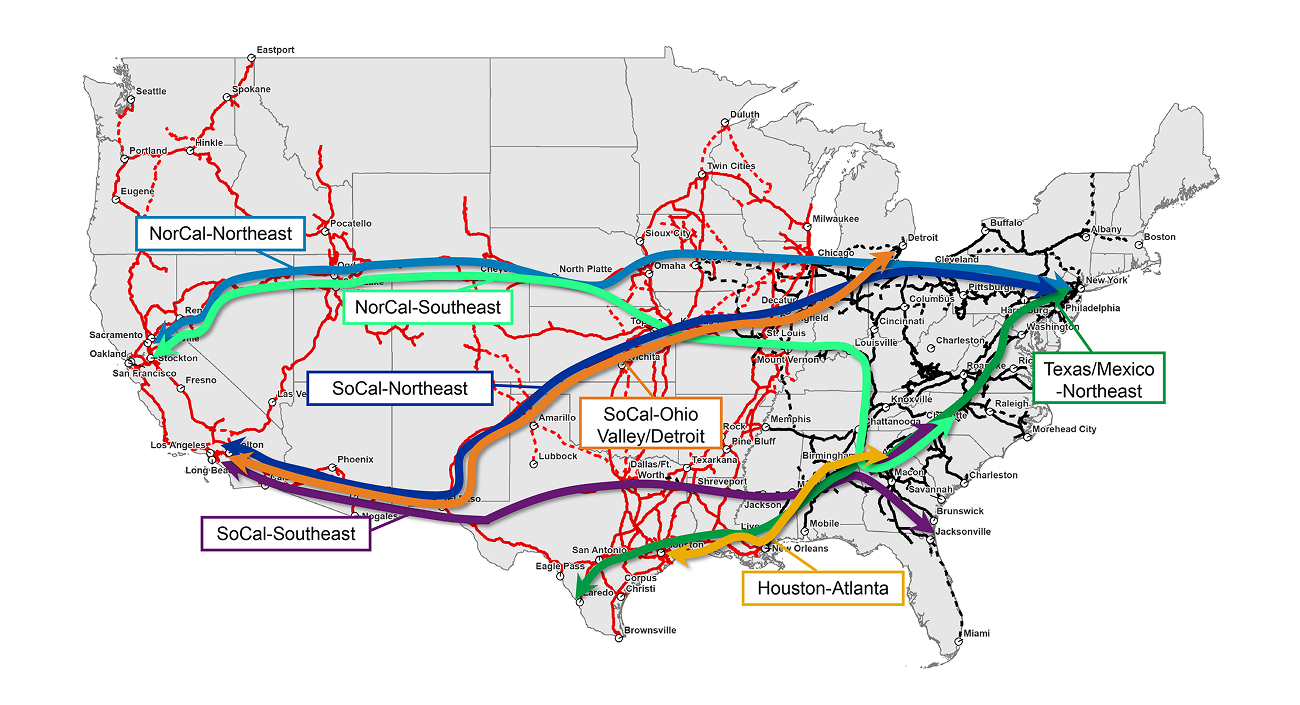
Investing in Cleaner Technologies
Giving Customers Better Sustainability Tools
“By moving large volumes of long-haul freight off highways and onto rail, the merger would improve roadway safety and reduce wear on public infrastructure. The analysis projects a major reduction in long-haul truck traffic on key interstate highway corridors as freight converts to rail under the merger.”
David Hunt
Vice President, Oliver Wyman, Statement to the STB
FAQ
Shifting freight from highway to rail reduces carbon emissions up to 75%, with one intermodal train removing as many as 550 trucks from the road. An Oliver Wyman study estimates the combined company will convert 2.1 million truckloads to rail annually — eliminating approximately 3.8 million metric tons of CO2 emissions and 3.6 billion truck-miles from public highways each year.
Today, trains must exchange freight at congested interchange hubs — and over 1,000 trucks move goods across Chicago alone every weekday to complete those handoffs. Single-line service eliminates those transfers, reducing truck traffic in interchange cities including Chicago, St. Louis, Kansas City and New Orleans and improving local air quality in the communities that surround those corridors.
The combined company will provide shippers with carbon calculators, rail emissions reports and biofuel credits. These tools are designed to help businesses quantify their transportation footprint, demonstrate measurable progress on Scope 3 emissions goals and make informed mode decisions with full environmental visibility.
Yes. Union Pacific is developing the industry’s first hybrid battery-electric locomotive and complete installation of an advanced Energy Management System across its entire fleet by 2026. Norfolk Southern’s locomotive upgrades extend unit life by at least 20 years while improving fuel efficiency by up to 25%. Both companies are also piloting emissions capture tender cars, which siphon off carbon and/or air pollutants without affecting locomotive power.
