Beyond the Main Line: Unlocking Rail Growth Through First- and Final-Mile Connectivity
Author: Stefan Loeb, Vice President Business Development and First and Final Mile Markets for Norfolk Southern | July 27, 2026
Key Takeaways:
● First- and final-mile access, not just network size, determines whether customers choose rail. Many shippers reject rail today simply because the artificial East-West divide between Class I networks makes it harder to reach than trucking alternatives.
● The combination would connect existing first- and final-mile infrastructure into one seamless network. Hundreds of transload facilities, 50+ port connections and one of the industry's largest short line partner networks would operate across 50,000+ route miles in 43 states instead of stopping at today's interchange points.
● This is about growing the overall freight market, not just one railroad's volume. By simplifying the customer experience for short lines, ports and transload partners alike, the combination creates new entry points for businesses that couldn't practically use rail before.
● First- and final-mile access, not just network size, determines whether customers choose rail. Many shippers reject rail today simply because the artificial East-West divide between Class I networks makes it harder to reach than trucking alternatives.
● The combination would connect existing first- and final-mile infrastructure into one seamless network. Hundreds of transload facilities, 50+ port connections and one of the industry's largest short line partner networks would operate across 50,000+ route miles in 43 states instead of stopping at today's interchange points.
● This is about growing the overall freight market, not just one railroad's volume. By simplifying the customer experience for short lines, ports and transload partners alike, the combination creates new entry points for businesses that couldn't practically use rail before.
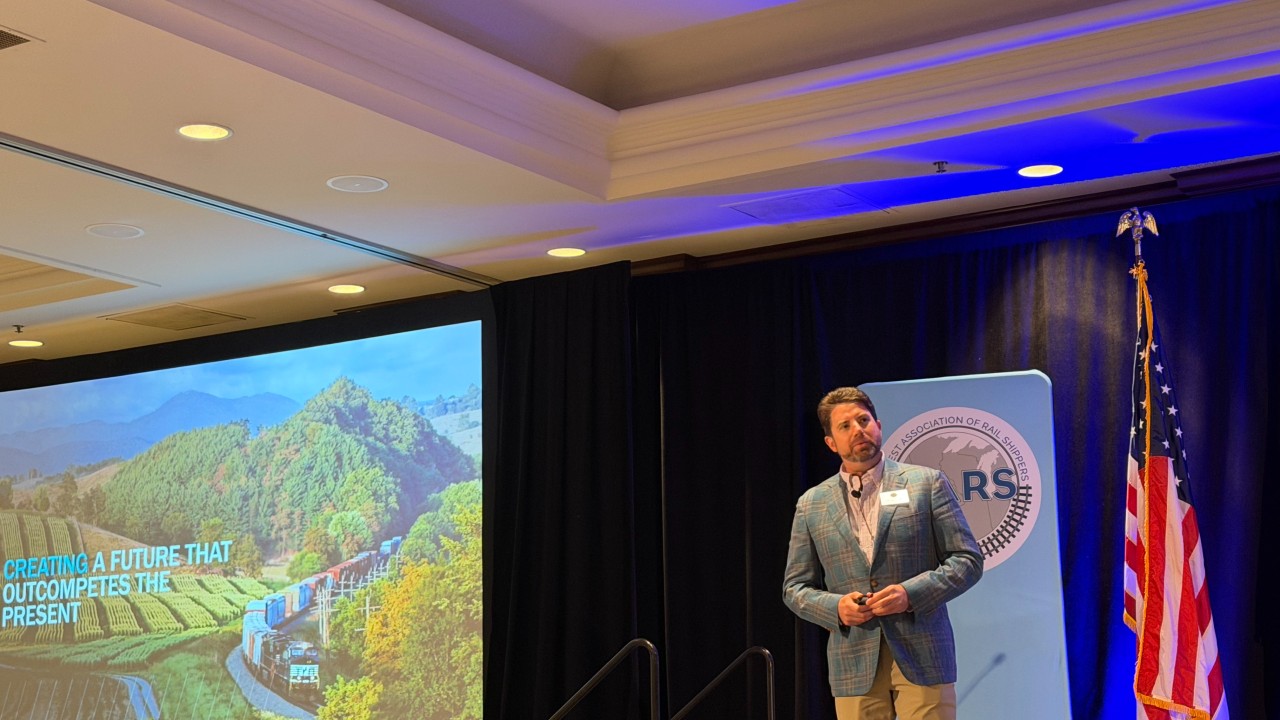

Stefan Loeb
Growth Begins With Access
As I shared at MARS, the groundwork for rail growth is happening at NS now. It starts with first- and final-mile solutions that make rail more accessible to customers. Those solutions are enabled by transload facilities, bulk terminals, rail-served industrial sites, port connections and short line partnerships that create entry points for customers who may not be located near a main line but still want to take advantage of rail's economic and environmental benefits. They are also why first- and final-mile solutions have become such an important part of Norfolk Southern's growth strategy. When those connections are in place, rail becomes more than transportation, it becomes a competitive advantage beyond our current network and solutions.
Building Capacity Where Customers Need It
The success we have seen from a highly connected, and collaborative supply chain has given me even greater confidence in the future of rail’s participation in our nation’s freight growth. That’s led us to invest further to grow our business through targeted capacity expansions, infrastructure improvements and shipment coordination/communication across the network. Recent initiatives include facility expansions, customer partnerships to add on-site storage capacity, truck scale upgrades and new equipment deployments designed to improve efficiency, increase throughput, and enhance speed to market.
Today, Norfolk Southern's network includes hundreds of transload locations and rail-served industrial sites, more than 50 port connections and one of the industry's largest short line partner networks. Partnerships with organizations like the Georgia Ports and the Doraville short line/transload deal (Norfolk Southern advances growth strategy with new short line partnership | Norfolk Southern) continue to expand our access to new markets while making it easier for customers to move freight efficiently across our network. Most importantly, we have the drive to always be looking for more. Because the growth is there.
Connecting More Markets, More Efficiently
This activity complements the already proven first- and final-mile strategies around the short line interchange program and transload partner growth strategy that continue to produce volume growth beyond our overall volume performance. Bringing together Union Pacific and Norfolk Southern can amplify today's first- and final-mile infrastructure using a seamless network spanning more than 50,000 route miles across 43 states. Customers utilizing transload facilities, bulk terminals and/or short line railroads wouldn't simply gain access to another railroad, they would gain more direct access to markets, ports on three coasts and cross-border trade through a simpler, more connected customer experience driven by a team, its proven solutions, and its drive to always be looking for the next thing.
Expanding Opportunity Across the Supply Chain
What excites me most is that this would unlock significant value by creating new opportunities and experiences for our customers, our employees, partners and the communities we serve. Our ports become more connected. Our short line partners gain access to new traffic opportunities and single line fluidity. Our transload network reaches more customers. And businesses that may not have considered rail before or could not ship to certain markets because of an arbitrary two railroad barrier, have new ways to participate in a fully integrated North American supply chain.
Growing the Market, Not Just the Network
When we simplify the customer experience while providing more value-creating solutions, we don't just grow one railroad, we create the conditions for the entire industry and our nation’s economy to grow, win, and importantly, participate in a more competitive freight market.
As I shared at MARS, the groundwork for rail growth is happening at NS now. It starts with first- and final-mile solutions that make rail more accessible to customers. Those solutions are enabled by transload facilities, bulk terminals, rail-served industrial sites, port connections and short line partnerships that create entry points for customers who may not be located near a main line but still want to take advantage of rail's economic and environmental benefits. They are also why first- and final-mile solutions have become such an important part of Norfolk Southern's growth strategy. When those connections are in place, rail becomes more than transportation, it becomes a competitive advantage beyond our current network and solutions.
Building Capacity Where Customers Need It
The success we have seen from a highly connected, and collaborative supply chain has given me even greater confidence in the future of rail’s participation in our nation’s freight growth. That’s led us to invest further to grow our business through targeted capacity expansions, infrastructure improvements and shipment coordination/communication across the network. Recent initiatives include facility expansions, customer partnerships to add on-site storage capacity, truck scale upgrades and new equipment deployments designed to improve efficiency, increase throughput, and enhance speed to market.
Today, Norfolk Southern's network includes hundreds of transload locations and rail-served industrial sites, more than 50 port connections and one of the industry's largest short line partner networks. Partnerships with organizations like the Georgia Ports and the Doraville short line/transload deal (Norfolk Southern advances growth strategy with new short line partnership | Norfolk Southern) continue to expand our access to new markets while making it easier for customers to move freight efficiently across our network. Most importantly, we have the drive to always be looking for more. Because the growth is there.
Connecting More Markets, More Efficiently
This activity complements the already proven first- and final-mile strategies around the short line interchange program and transload partner growth strategy that continue to produce volume growth beyond our overall volume performance. Bringing together Union Pacific and Norfolk Southern can amplify today's first- and final-mile infrastructure using a seamless network spanning more than 50,000 route miles across 43 states. Customers utilizing transload facilities, bulk terminals and/or short line railroads wouldn't simply gain access to another railroad, they would gain more direct access to markets, ports on three coasts and cross-border trade through a simpler, more connected customer experience driven by a team, its proven solutions, and its drive to always be looking for the next thing.
Expanding Opportunity Across the Supply Chain
What excites me most is that this would unlock significant value by creating new opportunities and experiences for our customers, our employees, partners and the communities we serve. Our ports become more connected. Our short line partners gain access to new traffic opportunities and single line fluidity. Our transload network reaches more customers. And businesses that may not have considered rail before or could not ship to certain markets because of an arbitrary two railroad barrier, have new ways to participate in a fully integrated North American supply chain.
Growing the Market, Not Just the Network
When we simplify the customer experience while providing more value-creating solutions, we don't just grow one railroad, we create the conditions for the entire industry and our nation’s economy to grow, win, and importantly, participate in a more competitive freight market.
Next Read: Building the Future of Rail Together