Future of Rail Symposium | CEOs to Industry Gathering: Bring on Competition
● The Union-Pacific and Norfolk Southern combination will strongly enhance industry competition. The Surface Transportation Board (STB) accepted the complete application that is pro-competitive and backed by a comprehensive plan for a smooth transition.
● Additional assurances go above and beyond any previous rail merger. The application doubled the scope of Committed Gateway Pricing (CGP) and added four new voluntary commitments to support competition.
● Customers benefit when railroads compete harder for their business. The combination fulfills customer requests for a single-line railroad responsible for shipments from origin to destination, with one service plan, one operating philosophy and one point of accountability.
Key Takeaways:
- A seamless transcontinental network expands freight options. The combination would create America’s first single-line coast-to-coast railroad with new lanes, faster routing and broader market access.
- Single-line service reduces supply chain friction. Fewer handoffs and more direct routing are designed to improve speed, reliability and efficiency for long-distance freight movement.
- The proposed combination strengthens American competitiveness.The applicationhighlights supply chain growth, new union jobs, and expanded rail capacity as long-term economic benefits.
Creating America’s first transcontinental railroad will have enhanced competition well beyond any previous rail merger, the CEOs of Union Pacific and Norfolk Southern told industry leaders Tuesday.
Union Pacific CEO Jim Vena and Norfolk Southern President and CEO Mark George made the comments in a joint interview with Trains Magazine editor Bill Stephens at the Future of Rail Symposium hosted July 28 by FreightWaves and Trains Magazine. The session is available to watch here.
The discussion took place at a time when momentum for the merger is building. The Surface Transportation Board (STB) accepted the merger application as complete; CN withdrew its opposition; and the railroads demonstrated their confidence by making four new voluntary commitments to support rail competition and protect customers.
Vena and George said they listened to feedback from customers and the STB. They realized there was an opportunity to show confidence in the merger and provide even more assurances the combination is pro-competitive and backed by a comprehensive plan for a smooth transition.
The railroads doubled the scope of Committed Gateway Pricing (CGP); ensured 2-to-1 and 3-to-2 shipper facilities will have access to an additional Class I railroad; created a mechanism to give customers alternative rail access in the unlikely event that service performance declines during merger integration; and proposed a new enforcement tool for the STB if expected merger benefits are not delivered in a timely manner.
“CGP opens it up and lets us go and compete,” Vena said. “It’ll put everybody’s feet to the fire more to compete even harder, and that’s what it’s all about. We’re willing to compete.”
“We’ve gone beyond what any Class I merger in the past has done in terms of offering new competition,” George said. “When you couple that with what we did through our agreement with CN, we’re changing the competitive landscape for the better.”
The agreement with CN, including expanded use of the Elgin, Joliet & Eastern Railway, would not have happened without the prospect of the merger, Vena said. “I wouldn’t have gotten through the turnstiles. They would’ve kicked me out of the building.”
Beyond increasing railroad competition, the CEOs emphasized the direct benefits for customers. A combined Union Pacific and Norfolk Southern would create 88,000 new single-line lanes, eliminating many of the handoffs that today occur between eastern and western railroads. George said customers consistently tell him they want one railroad responsible for their shipment from origin to destination, with one service plan, one operating philosophy and one point of accountability.
“What we’re doing with the merger is truly transforming, creating 88,000 new single-line lanes,” George said. “We know when single-line service is offered, shippers are 2-3 times more likely to select rail versus truck. We are creating an enormous public benefit when we come together by offering all these new single-line options.”
George said those benefits translate into meaningful opportunities for growth, particularly across the Mississippi River watershed, where many customers today rely on trucks or complex interline rail moves to reach new markets. He noted that every eliminated interchange removes risk, reduces variability and improves reliability – factors that directly influence purchasing decisions. Examples include finished vehicle shipments from Georgetown, Indiana, to Mira Loma, California, which could move more than 48 hours faster; chemical traffic moving from Old Fort, Ohio, to Green River, Wyoming, with approximately 24 hours of transit improvement; and paper and consumer products shipments from Jackson, Alabama, to Salem, Oregon, with roughly 48 hours savings. Both CEOs consistently acknowledged that customers don't buy handoffs, they buy speed, consistency, and accountability.
For Vena, the bottom line is simple: customers benefit when railroads compete harder for their business.
“At the end of the day, the end user of the product would say, let them go compete,” he said. "[The other railroads] can drop their price. They can provide a higher level of service to compete against us. They are very strong. We’re going to protect railroads that want to be inefficient? I don’t think so.”
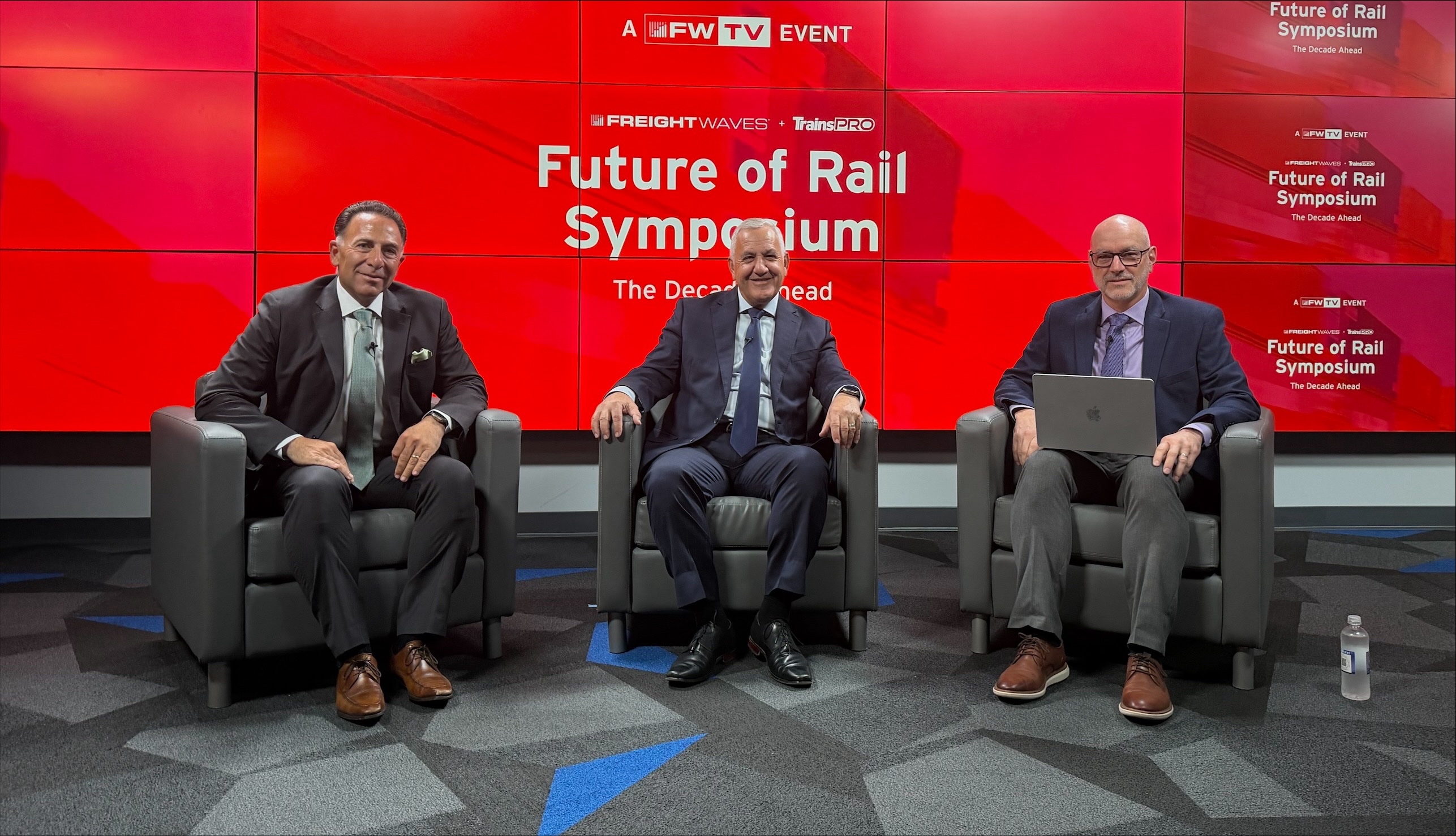
From left, Norfolk Southern President and CEO Mark George; Union Pacific CEO Jim Vena; and Trains Magazine Editor Bill Stephens.
Creating America’s first transcontinental railroad will have enhanced competition well beyond any previous rail merger, the CEOs of Union Pacific and Norfolk Southern told industry leaders.
Union Pacific CEO Jim Vena and Norfolk Southern President and CEO Mark George made the comments in a joint interview with Trains Magazine editor Bill Stephens at the Future of Rail Symposium hosted July 28 by FreightWaves and Trains Magazine. The session is available to watch here.
The discussion took place at a time when momentum for the merger is building. The Surface Transportation Board (STB) accepted the merger application as complete; CN withdrew its opposition; and the railroads demonstrated their confidence by making four new voluntary commitments to support rail competition and protect customers.
Vena and George said they listened to feedback from customers and the STB. They realized there was an opportunity to show confidence in the merger and provide even more assurances the combination is pro-competitive and backed by a comprehensive plan for a smooth transition.
The railroads doubled the scope of Committed Gateway Pricing (CGP); ensured 2-to-1 and 3-to-2 shipper facilities will have access to an additional Class I railroad; created a mechanism to give customers alternative rail access in the unlikely event that service performance declines during merger integration; and proposed a new enforcement tool for the STB if expected merger benefits are not delivered in a timely manner.
“CGP opens it up and lets us go and compete,” Vena said. “It’ll put everybody’s feet to the fire more to compete even harder, and that’s what it’s all about. We’re willing to compete.”
“We’ve gone beyond what any Class I merger in the past has done in terms of offering new competition,” George said. “When you couple that with what we did through our agreement with CN, we’re changing the competitive landscape for the better.”
Vena called the agreement with CN “a big deal” for rail-to-rail competition. “We allowed competition for products that originate in Canada to get to Mexico in a much more seamless manner,” he said. “So, we just increased competition between CN and CPKC coming out of Canada.”
The agreement with CN, including expanded use of the Elgin, Joliet & Eastern Railway, would not have happened without the prospect of the merger, Vena said. “I wouldn’t have gotten through the turnstiles. They would’ve kicked me out of the building.”
Beyond increasing railroad competition, the CEOs emphasized the direct benefits for customers. A combined Union Pacific and Norfolk Southern would create 88,000 new single-line lanes, eliminating many of the handoffs that today occur between eastern and western railroads. George said customers consistently tell him they want one railroad responsible for their shipment from origin to destination, with one service plan, one operating philosophy and one point of accountability.
“What we’re doing with the merger is truly transforming, creating 88,000 new single-line lanes,” George said. “We know when single-line service is offered, shippers are 2-3 times more likely to select rail versus truck. We are creating an enormous public benefit when we come together by offering all these new single-line options.”
George said those benefits translate into meaningful opportunities for growth, particularly across the Mississippi River watershed, where many customers today rely on trucks or complex interline rail moves to reach new markets. He noted that every eliminated interchange removes risk, reduces variability and improves reliability – factors that directly influence purchasing decisions. Examples include finished vehicle shipments from Georgetown, Indiana, to Mira Loma, California, which could move more than 48 hours faster; chemical traffic moving from Old Fort, Ohio, to Green River, Wyoming, with approximately 24 hours of transit improvement; and paper and consumer products shipments from Jackson, Alabama, to Salem, Oregon, with roughly 48 hours savings. Both CEOs consistently acknowledged that customers don't buy handoffs, they buy speed, consistency, and accountability.
For Vena, the bottom line is simple: customers benefit when railroads compete harder for their business.
“At the end of the day, the end user of the product would say, let them go compete,” he said. "[The other railroads] can drop their price. They can provide a higher level of service to compete against us. They are very strong. We’re going to protect railroads that want to be inefficient? I don’t think so.”