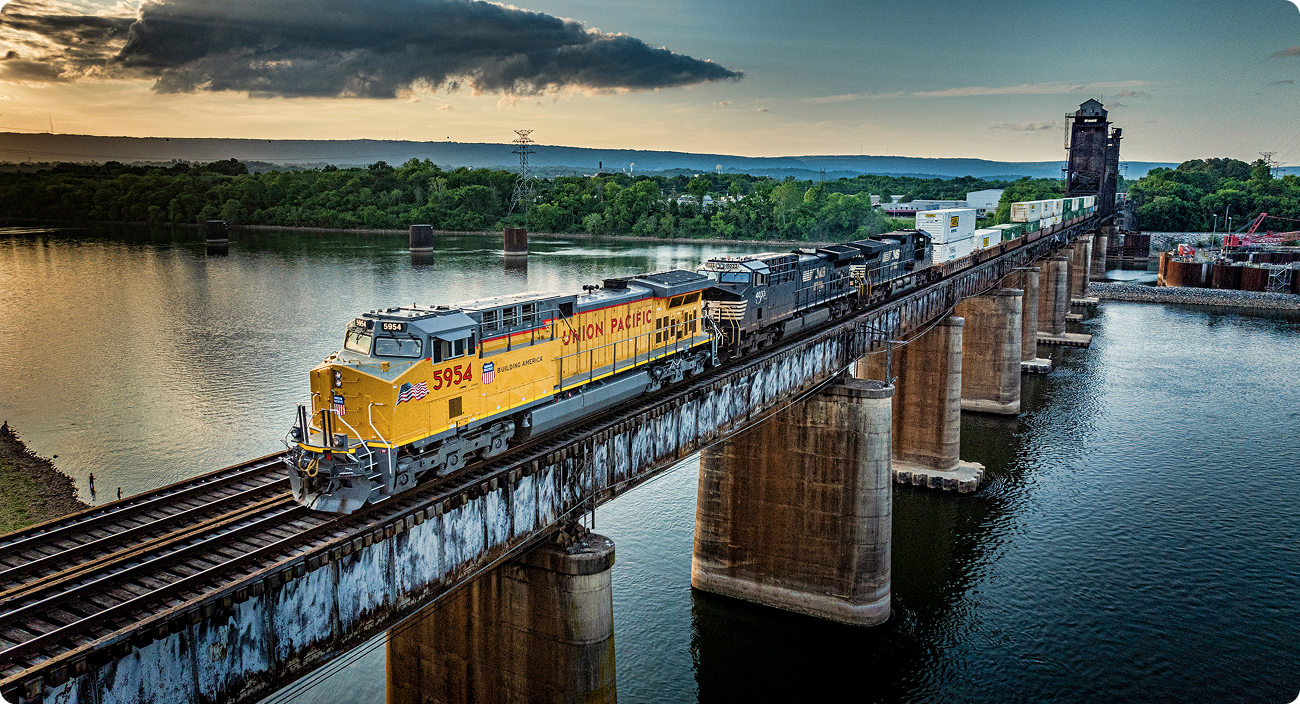
A faster way across the country
Nearly 500 million tons of freight move through the region surrounding the major gateways between eastern and western railroads — the Watershed.
It is one of the most important freight corridors in the country. It is also one of the most constrained.
Today, shipments crossing this divide often change railroads, sometimes multiple times. Each handoff adds time, cost and complexity. For many shippers, rail becomes too difficult to use and freight moves by truck instead.
It is one of the most important freight corridors in the country. It is also one of the most constrained.
Today, shipments crossing this divide often change railroads, sometimes multiple times. Each handoff adds time, cost and complexity. For many shippers, rail becomes too difficult to use and freight moves by truck instead.
The bottleneck in the middle of America
Steel, grain, lumber, chemicals and manufactured goods move through the Watershed region each year. This is the stretch of the country within roughly 250 miles of the major gateways between eastern and western railroads. It includes Chicago, St. Louis, Kansas City, Memphis, Birmingham, Louisville and New Orleans — some of the most important freight hubs in North America.
It should be the most efficient part of the network. The issue is the gateway-watershed problem — a structural constraint that has existed as long as the railroads themselves.
Federal regulators recognize the dynamic. The Interstate Commerce Commission described it as a fundamental constraint on traffic flow, where carriers near interchange points lack the economic incentive to fully participate in long-haul movements.
In other words, customers near the divide face fewer rail service options, higher costs and greater complexity. Freight that should move by rail moves by truck instead.
It should be the most efficient part of the network. The issue is the gateway-watershed problem — a structural constraint that has existed as long as the railroads themselves.
Federal regulators recognize the dynamic. The Interstate Commerce Commission described it as a fundamental constraint on traffic flow, where carriers near interchange points lack the economic incentive to fully participate in long-haul movements.
In other words, customers near the divide face fewer rail service options, higher costs and greater complexity. Freight that should move by rail moves by truck instead.
Turn the Watershed into a fast lane
Removing the handoffs immediately changes the system.
For the first time, shippers in the Watershed will gain access to single-line service across long-distance routes. Freight will move under one operating plan from origin to destination with no transfers or fragmentation.
That shift unlocks scale. Of the 88,000 new county-to-county lanes enabled by the network, 45,000 are in Watershed markets.
Routes that were previously inefficient or unavailable by rail will become viable. The middle of the country stops being a barrier and starts acting like a corridor.
For the first time, shippers in the Watershed will gain access to single-line service across long-distance routes. Freight will move under one operating plan from origin to destination with no transfers or fragmentation.
That shift unlocks scale. Of the 88,000 new county-to-county lanes enabled by the network, 45,000 are in Watershed markets.
Routes that were previously inefficient or unavailable by rail will become viable. The middle of the country stops being a barrier and starts acting like a corridor.
.png)
Volume increases when rail works
When rail becomes predictable, freight comes back.
Oliver Wyman estimates 112,100 carloads of merchandise traffic will shift from road to rail once single-line service reaches the Watershed region.
That’s what happens when the friction comes out: Fewer handoffs, delays and transit times you can plan around. A rail product that can compete with long-haul trucking on both cost and reliability.
Oliver Wyman estimates 112,100 carloads of merchandise traffic will shift from road to rail once single-line service reaches the Watershed region.
That’s what happens when the friction comes out: Fewer handoffs, delays and transit times you can plan around. A rail product that can compete with long-haul trucking on both cost and reliability.
Less friction. More flow
In agriculture, the current system drags on every shipment. Gateway delays slow access to inland elevators and export ports, adding cost at every step. Remove the handoffs, and those routes open up — east to the Atlantic, south to the Gulf — with timing that actually holds.
For chemicals, the shift is immediate. Oliver Wyman estimates 44,000 carloads will move from road to rail once single-line service reaches the Watershed.
These are high-value moves in high-cost equipment. Faster turns mean better utilization, less inventory sitting still and lower overall cost. With fewer handlings, there’s less exposure, especially for hazardous shipments.
Less stopping, more moving: a system that works at scale.
For chemicals, the shift is immediate. Oliver Wyman estimates 44,000 carloads will move from road to rail once single-line service reaches the Watershed.
These are high-value moves in high-cost equipment. Faster turns mean better utilization, less inventory sitting still and lower overall cost. With fewer handlings, there’s less exposure, especially for hazardous shipments.
Less stopping, more moving: a system that works at scale.
“We believe this will help link our rural communities to more markets. In practical terms, that means our co-op can move Minnesota and Iowa corn and soybeans to customers on the Eastern Seaboard or Gulf Coast seamlessly and bring in fertilizer and feed ingredients from afar with less disruption.”
KC Graner
President and CEO, Central Farm Service
FAQ
Why has rail service been limited in the Watershed region?
Because freight has to change hands between railroads at the East–West divide. These handoffs add cost, delay and complexity.
What is the “gateway Watershed” problem?
It’s a structural constraint where railroads terminate within 250 miles of the major gateways between eastern and western railroads. Trucking is often the only option because crossing the divide makes rail too expensive and complicated due to handoffs between railroads.
How does this combination improve service in the Watershed?
It removes the need for interline handoffs. For the first time, shippers in the region gain access to single-line service. This means one route, one plan and more consistent transit times across long-distance shipments.
Make Your Voice Heard
Explore More
